Walk into a room painted sunshine yellow and you’ll feel energized. Step into a slate-blue bedroom and your shoulders drop. That’s not magic, it’s color theory at work. Understanding how colors interact, contrast, and influence mood isn’t just for designers with mood boards and pantone decks. It’s a practical tool that helps DIYers make smarter paint choices, avoid costly re-dos, and create rooms that actually feel the way they’re supposed to. Whether you’re refreshing a single accent wall or planning a whole-house palette, knowing the basics of color relationships will save you time, money, and second-guessing at the paint counter.
Table of Contents
ToggleKey Takeaways
- Color theory interior design gives homeowners a practical framework for choosing paint, fabrics, and accessories that work together harmoniously, reducing costly mistakes and repainting.
- Understanding the 12-color wheel and how primary, secondary, and tertiary colors relate helps you predict how paint colors will behave next to existing trim, flooring, and furniture.
- Proven color schemes like monochromatic, complementary, and analogous combinations provide tested starting points; the 60-30-10 color rule (60% dominant, 30% secondary, 10% accent) prevents any single color from overpowering a space.
- Temperature, value, and saturation control mood more than hue alone—warm colors make rooms cozier, cool colors expand perceived space, light values add airiness, and muted tones relax better than saturated ones.
- Test paint samples on two walls (one with direct light, one in shadow) for at least 48 hours before committing, since lighting, surrounding colors, and surface texture dramatically shift how a color appears in your specific room.
- Match paint choice to room function: kitchens and bathrooms need moisture-resistant finishes, bedrooms benefit from cooler muted tones for rest, and living areas work best with warmer colors that encourage conversation.
What Is Color Theory and Why Does It Matter in Interior Design?
Color theory is the study of how colors relate to each other and how they’re perceived by the human eye. It started with painters and printers, but interior designers co-opted it because the same principles that make a painting cohesive also make a living room feel balanced.
In practical terms, color theory gives you a framework for choosing paint, fabrics, rugs, and accessories that work together instead of clashing. It explains why certain combinations feel harmonious (analogous colors like blue and green) and why others create visual tension (complementary pairs like orange and blue). It also clarries why a color looks different in your hallway versus the paint store, lighting, surrounding colors, and surface texture all shift perception.
For homeowners, this matters because paint is one of the cheapest ways to transform a space, but it’s also one of the easiest to get wrong. A gallon of interior paint covers roughly 350–400 square feet, so a misstep means wasted material, labor, and time. Color theory reduces guesswork. Instead of buying six sample jars and repainting test patches, you can narrow choices using proven combinations and adjust for the room’s function, lighting, and existing finishes.
Understanding the Color Wheel for Interior Spaces
The color wheel is your road map. It organizes colors in a circle to show their relationships, which ones sit next to each other, which ones oppose, and how they’re mixed. Most wheels used in interior design spaces are 12-color models, but the logic scales up or down.
Primary, Secondary, and Tertiary Colors Explained
Primary colors, red, blue, and yellow, can’t be made by mixing other colors. They’re the foundation. In paint, these translate to bold, saturated hues that rarely work as whole-room colors unless you’re going for high drama (think a primary-red dining room or cobalt accent wall).
Secondary colors are made by mixing two primaries: orange (red + yellow), green (blue + yellow), and violet (red + blue). These are common in home interiors because they’re vibrant but less intense than primaries. A soft sage green or muted terracotta can anchor a room without overwhelming it.
Tertiary colors result from mixing a primary and a secondary. Examples include red-orange, yellow-green, and blue-violet. These are the workhorses of interior palettes, they’re complex, nuanced, and easier to live with long-term. Most neutral-plus-accent schemes rely on tertiary shades for depth.
When you’re standing in the paint aisle staring at 47 shades of greige, remember that each chip is a variation in value (lightness/darkness), saturation (intensity), and temperature (warm vs. cool). The wheel helps you see the underlying hue and predict how it’ll behave next to trim, flooring, or furniture.
Essential Color Schemes Every Homeowner Should Know
Color schemes are pre-tested formulas. They’re not rules, but they do give you a starting point that’s statistically likely to work. Here are the ones that show up most in real homes.
Monochromatic schemes use one hue in multiple values and saturations, think a bedroom in pale blue walls, medium blue bedding, and navy curtains. It’s foolproof and calming, but it can read flat if you don’t vary texture (linen, velvet, painted wood) to add visual interest.
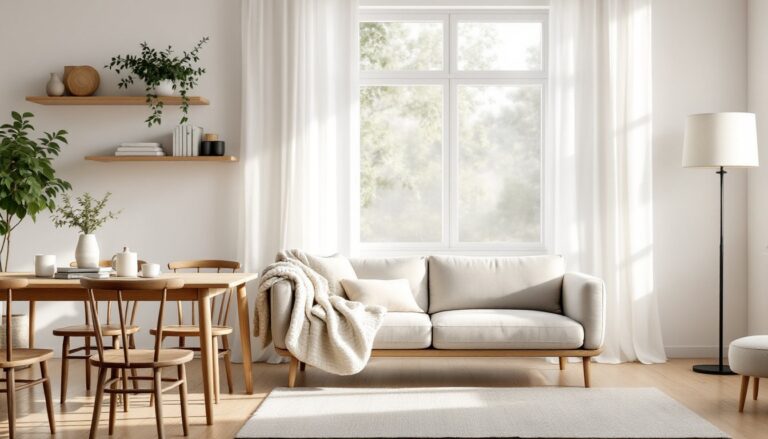
Neutral schemes rely on whites, grays, beiges, and blacks. Contrary to popular belief, neutrals aren’t boring, they’re strategic. They let architecture, art, and natural light do the talking. A cozy living room often uses warm neutrals like cream and taupe to create a restful backdrop.
Many pros follow the 60-30-10 color rule, allocating 60% to a dominant color (usually walls), 30% to a secondary color (upholstery, rugs), and 10% to an accent (pillows, art). This prevents any single color from overpowering the space and keeps the eye moving.
Complementary and Analogous Color Combinations
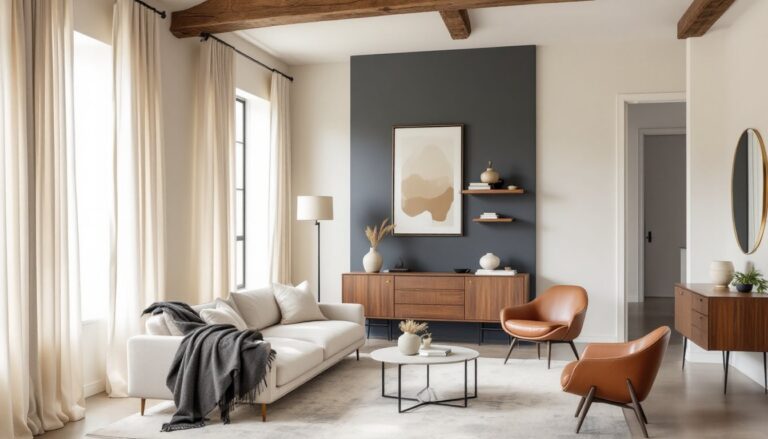
Complementary schemes pair colors opposite each other on the wheel, blue and orange, red and green, yellow and purple. These create high contrast and energy, so they’re better suited to accent walls, powder rooms, or modern art deco interiors where drama is the goal. In a full room, temper one color by using a muted or lighter version (navy + soft peach instead of royal blue + neon orange).
Analogous schemes use three colors that sit side by side on the wheel, like blue, blue-green, and green. These are naturally harmonious and common in nature, which is why they feel restful. They’re ideal for bedrooms, bathrooms, and open-concept spaces where you want visual flow without jarring transitions.
Triadic schemes use three colors evenly spaced on the wheel (red, yellow, blue). They’re vibrant and balanced but tricky to execute without looking like a preschool. Stick to one dominant color and use the other two sparingly as accents.
How to Choose the Right Colors for Each Room
Function drives color choice. A room’s purpose, natural light, and size should all influence your palette.
Kitchens handle heat, humidity, and grease, so choose paints labeled “kitchen and bath” with a satin or semi-gloss finish for scrubbability. Warm neutrals (cream, soft gray, greige) are timeless and pair well with wood, stone, and stainless steel. If you want color, consider it on an island or lower cabinets rather than all four walls.
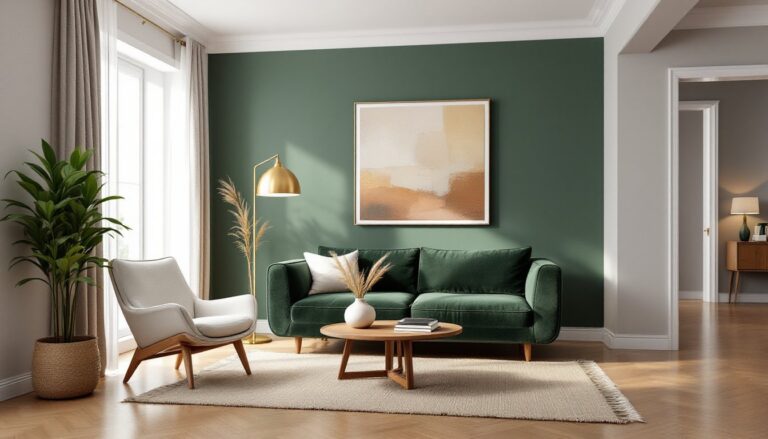
Bedrooms benefit from cooler, muted tones, soft blues, greens, lavenders, that lower heart rate and signal rest. Avoid high-contrast schemes unless you’re a light sleeper who doesn’t mind visual stimulation. Darker colors (charcoal, deep green) can work in a large bedroom with good natural light, but test samples first: they can make a small room feel cave-like.
Bathrooms are often small and windowless, which makes lighter colors the safer bet. Whites, pale grays, and spa-inspired blues maximize the light you do have. Semi-gloss or high-gloss paint resists moisture better than flat. Accent with towels and accessories rather than committing to bold wall color you’ll tire of.
Living rooms and dining rooms are social spaces where slightly warmer tones (taupe, terracotta, soft gold) encourage conversation. These rooms often share sightlines with hallways and kitchens, so choose colors that flow visually. Ceiling paint should typically be flat white unless you’re deliberately creating contrast or working with an industrial interior where exposed structure and dark ceilings add character.
Home offices need focus without fatigue. Mid-tone greens and blues reduce eye strain and promote concentration. Avoid overly stimulating colors (bright red, neon yellow) unless you’re in a creative field and want that energy boost.
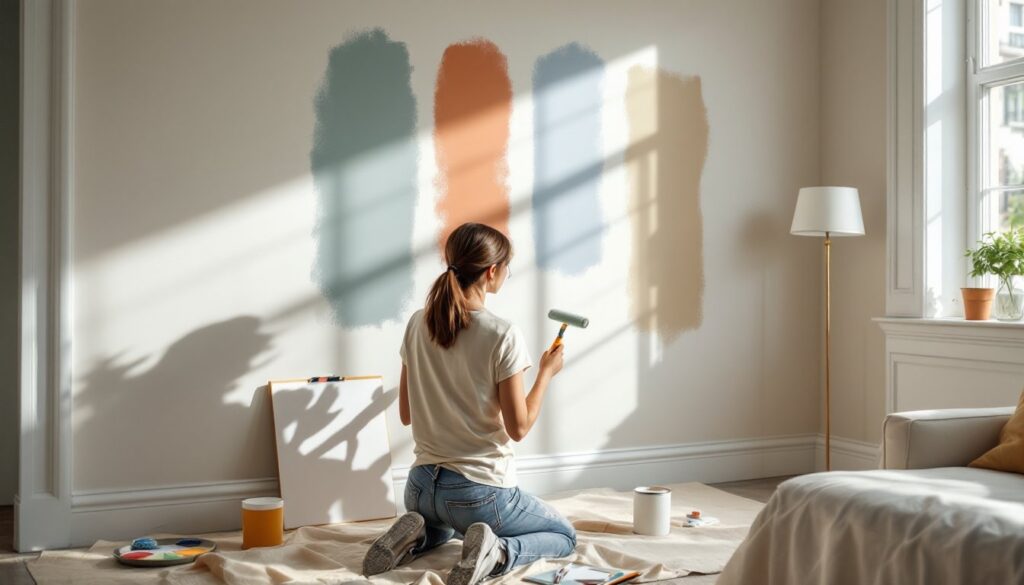
Always test paint samples on at least two walls, one that gets direct light and one in shadow. Colors shift dramatically depending on exposure. Paint a 2×2-foot patch minimum and live with it for 48 hours before committing to gallons.
Using Temperature, Value, and Saturation to Set the Mood
Beyond hue, three variables control how a color feels in a room: temperature, value, and saturation. Mastering these lets you fine-tune mood without changing the base color.
Temperature refers to warm (reds, oranges, yellows) versus cool (blues, greens, purples). Warm colors advance visually, making walls feel closer and rooms cozier, great for north-facing rooms or large spaces that feel cold. Cool colors recede, making small rooms feel larger and sunny rooms less intense. A small condo space often benefits from cool, light tones to maximize perceived square footage.
Even neutrals have temperature. Beige with a yellow undertone reads warm: gray with a blue undertone reads cool. Mix the wrong neutral with your lighting (warm LED bulbs in a cool gray room) and the space will feel off. Test paint next to your light fixtures, not just in daylight.
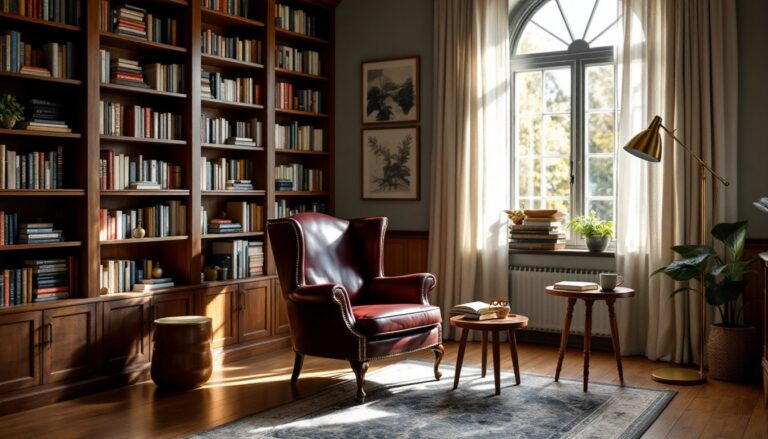
Value is the lightness or darkness of a color. High-value (light) colors reflect more light and make rooms feel airy. Low-value (dark) colors absorb light and create intimacy. You can use the same hue, say, green, in a pale mint (high value) for a nursery or a deep forest (low value) for a library. Contrast in value also creates visual interest: white trim pops against dark walls, while tone-on-tone (low contrast) feels subtle and modern.
Saturation is color intensity. Highly saturated colors (pure, vivid) energize and demand attention. Desaturated colors (grayed-out, muted) relax and recede. A saturated cobalt blue works as an accent wall, but four walls of it will exhaust you. Desaturated equivalents like dusty blue or slate work for whole rooms.
Combining these three lets you customize mood without repainting. Swap saturated throw pillows for muted ones and the room calms down. Add warm wood tones to a cool gray room and it feels less sterile. Interior design enthusiasts on community forums often share before-and-after photos showing how small temperature or saturation shifts transform a space.
Safety note: When painting, always use a respirator mask rated for VOCs (volatile organic compounds), not just a dust mask. Ensure adequate ventilation, open windows and use box fans to exhaust fumes. If you’re painting trim, cabinets, or anything requiring sanding, wear safety goggles and a dust mask rated N95 or higher. Even low-VOC paints release fumes during application and curing.
Color theory isn’t about memorizing rules, it’s about understanding relationships so you can break the rules intentionally. Start with a tested scheme, adjust for your room’s quirks, and don’t be afraid to sample liberally. A $5 sample jar and a foam brush will teach you more than any blog post.